
'Growth, liquidity and deposit mobilisation are likely to be discussed during the interaction.'

India's housing market has remained resilient this festival season (Dussehra-Diwali period), despite global macroeconomic challenges, tech-sector layoffs, and affordability pressures, with developers reporting 10-25 per cent year-on-year (Y-o-Y) rise in home sales across major cities.

India is growing fast, but to keep growing strong, the government must make more things at home, create jobs, and spend money wisely, suggests Rajiv Memani, regional managing partner, Africa-India Region, EY.

Wholesale inflation fell to a 3-month low of 2.04 per cent in July on decline in prices of food items especially vegetables, government data released on Wednesday showed. The decline in wholesale price index (WPI) based inflation in July came after it rose for four months in a row till June, when it was 3.36 per cent. It was (-) 1.23 per cent in July last year. In April wholesale inflation stood at 1.19 per cent.

India, the world's fourth largest economy, is set to maintain the 'goldilocks' phase with tailwinds of good growth, low inflation and robust banking performance as well as reform initiatives poised to sustain the economic pace witnessed during 2025.
The size of the Reserve Bank's balance sheet as on March 31, 2025 increased by 8.20 per cent year-on-year, leading to a bumper dividend of Rs 2.69 lakh crore for the central government. Increase on assets side was due to rise in gold, domestic investments and foreign investments by 52.09 per cent, 14.32 per cent and 1.70 per cent, respectively, said the RBI's Annual Report for the Year 2024-25 released on Thursday.

Perhaps because the Modi government had some differences of opinion with two of the economist governors (one of whom was appointed by the Manmohan Singh government), there is a view that its political leadership prefers a civil servant to head the RBI, notes A K Bhattacharya.

Since Sanjay Malhotra took office as governor in December, the Reserve Bank of India (RBI) has adopted a more accommodative stance, which bodes well for banking and the economy as they navigate a growth slowdown, according to analysts.

Retail inflation slipped to 1.54 per cent in September from 2.07 per cent in the preceding month mainly due to subdued prices of food items, including vegetables and pulses, according to government data released on Monday. The consumer price index (CPI) based inflation was 5.49 per cent in September 2024.

Wholesale price inflation rose to a 4-month high of 2.36 per cent in October as prices of food items, especially vegetables, and manufactured goods turned dearer, as per the government data released on Thursday. The wholesale price index (WPI) based inflation was 1.84 per cent in September 2024. It was (-) 0.26 per cent in October, last year.

Rising for the sixth consecutive session, gold prices rallied Rs 1,000 to hit yet another record high of Rs 105,670 per 10 grams in the national capital on Monday, lifted by expectations of a rate cut by the US Federal Reserve this month and robust demand in overseas markets.
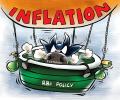
The Reserve Bank of India on Friday retained its projection for retail inflation at 4.5 per cent for the current fiscal assuming a normal monsoon, while emphasising that uncertainties related to food price outlook warrant a close monitoring. Consumer Price Index (CPI)-based retail inflation has been projected at 4.5 per cent with quarter-wise projections at 4.9 per cent in Q1 (April-June), 3.8 per cent in Q2, 4.6 per cent in Q3, and 4.5 per cent in Q4.

'The outlook for the next Samvat is more constructive, as many of the earlier drags are gradually becoming supports.'

As a protege of Shinzo Abe, Takaichi is expected to scale bilateral ties much higher. Trade and investment shall grow. People-to-people contacts shall be scaled up, points out Dr Rajaram Panda.

'Calibrated depreciation will help rebalance external fundamentals, offset some of the tariff differentials with competitors, improve the competitiveness of domestic substitutes vis-a-vis Chinese imports, and contribute to the easing of financial conditions at a time when the inflation rate is unusually low,' explains Sajjid Z Chinoy, head of Asia Economics at JP Morgan.

A day after his appointment as the 26th governor of the Reserve Bank of India (RBI), outgoing Revenue Secretary Sanjay Malhotra on Tuesday said one must understand the economic landscape and do what was best for the economy. "Let me first go, join, understand the turf ... Here it is a different role," Malhotra said, speaking to reporters in front of North Block.

The Reserve Bank of India's (RBI's) job to bring down inflation is not over, and any premature move on the policy front could undermine the success achieved so far on the price situation, according to RBI Governor Shaktikanta Das. RBI's rate setting panel, Monetary Policy Committee (MPC), had met for three days from February 6-8. The panel decided to leave the key policy rate unchanged at 6.5 per cent for the sixth time in row.
The Reserve Bank of India on Thursday decided to keep policy rate unchanged for the sixth time in a row as it maintains a tight vigil on inflation. The rate increase cycle was paused in April last year after six consecutive rate hikes aggregating to 250 basis points since May 2022.

The Reserve Bank of India's (RBI) Monetary Policy Committee's (MPC) decision to cut the repo rate by 50 basis points (bps) to 5.5% was contrary to the expectations of many economists. Firstly, most of the economists expected the MPC to cut the repo rate by 25 bps citing the weakening of inflation, prospects of economic growth, geopolitical uncertainty and comfortable system liquidity.

Even as the high inflation figure for October has ruled out any possibility of a rate cut by the Reserve Bank of India's (RBI's) monetary policy committee (MPC) in December, a rate cut in February also looks uncertain due to global uncertainties. Economists told Business Standard that unless domestic growth slows markedly, the outlook on rate cut remains unclear. India's headline inflation touched a 14-month high of 6.2 per cent in October, breaching the MPC's upper tolerance band of 6 per cent.

India's annual oil import bill could rise by $9-11 billion if the country is compelled to move away from Russian crude in response to US threats of additional tariffs or penalties on Indian exports, analysts said. India, the world's third-largest oil consumer and importer, has reaped significant benefits by swiftly substituting market-priced oil with discounted Russian crude following Western sanctions on Moscow after its invasion of Ukraine in February 2022.

India Ratings on Thursday said that any broad-based or strong recovery in corporate capital expenditure was unlikely in the upcoming financial year 2026 (FY26) due to uncertainty of domestic and external demand. The uncertainty is adversely affecting the overall corporate sector capex. Interest rates on credit are not the primary deterrent to decisions about capital expenditure, said Soumyajit Niyogi, director, core analytical group, Ind-Ra, in a webinar on the credit market outlook.

The RBI has already hiked interest rates 12 times since March, 2010, to control inflation, which is currently hovering near the double-digit mark.

Budget 2026 sticks to fiscal discipline, shuns populist measures despite five key state elections coming up, but ends up rattling stock markets with a higher transaction tax on derivatives trading.

Among Sensex firms, Eternal, Infosys, Asian Paints, HDFC Bank, Bajaj Finserv and Titan were the major gainers. However, Tata Steel, Tech Mahindra, Adani Ports and Bharat Electronics were among the laggards.

Net foreign direct investment (FDI) in India, inflows minus outflows, declined sharply in April-August this year to $2.99 billion from $18.03 billion in the same period last year on moderation in global activities and a rise in repatriation. The Reserve Bank of India's data (October 2023 bulletin) said FDI in India was $7.28 billion and FDI by India, that is money invested abroad from the country, was $4.28 billion in April-August 2023. As for 2022, FDI in India was $22.79 billion and FDI by India was $4.76 billion in April-August.

To those who ask, "Is all this really worth it? Why can't domestic demand fill the gap?", it is important to remind them that only 13 economies since the Second World War have grown at 7 per cent or more for 25 years -- like India needs to. They all had one thing in common: Strong export growth underpinned by strong global engagement, explains Sajjid Z Chinoy.

Benchmark equity indices Sensex and Nifty pared early gains to settle lower on Wednesday due to late selling in index major Reliance Industries, ITC and HDFC Bank even as the RBI took the first step towards a rate cut in its monetary policy review. Erasing its early gains, the 30-share BSE Sensex fell 167.71 points or 0.21 per cent to close at 81,467.1. During the day, it surged 684.4 points or 0.83 per cent to hit an intra-day high of 82,319.21.

The Reserve Bank on Friday said India is poised to become the growth engine of the world as it retained the GDP projection for the current fiscal at 6.5 per cent. Unveiling the bi-monthly monetary policy review, Reserve Bank of India (RBI) Governor Shaktikanta Das said the domestic economy exhibits resilience on the back of strong demand.

Union Finance Minister Nirmala Sitharaman's call for making lending rates affordable may not resonate anytime soon as banks still struggle with margin compression, and await clues from the Reserve Bank of India (RBI) on liquidity and rate action. Hinting that any lending rate cut was some time away, State Bank of India (SBI) managing director Vinay M Tonse said there was still some aggression in the market regarding deposit pricing.

In the context of RBI's view that the real interest rate, defined as the repo rate less "look forward" CPI, should be around 150-200 basis points.

Facing criticism from the government over the central bank prioritising inflation over growth, the new RBI Governor Sanjay Malhotra on Monday said that prospects of the Indian economy are expected to improve on the back of high consumer and business confidence in 2025. "As we strive to preserve financial stability to support a higher growth path for the Indian economy, our focus remains steadfast on maintaining stability of financial institutions and, more broadly, systemic stability," Malhotra said in foreword to the Financial Stability Report.

Miller said that US President Donald Trump has a 'tremendous' relationship with Prime Minister Narendra Modi, and that the peace options for the region are on the table.

Fitch Ratings on Wednesday raised India's GDP growth forecast to 6.9 per cent for current fiscal year, from 6.5 per cent earlier, citing strong June quarter growth and domestic consumption-led demand.

Clarity on Tata Sons' position on listing, as of 2025, would help define the future of the group better, irrespective of the RBI stand. As of now, the ball is in the RBI's court, and everyone is watching the space, points out Nivedita Mookerji.

With retail inflation witnessing significant uptick in May, the Reserve Bank of India (RBI) is likely to maintain status quo in its August monetary policy review, according to a report. According to the SBI's research report- Ecowrap, inflation may remain elevated in the coming months due to several global and domestic factors. "We expect a status-quo in August. We believe RBI would still try to find a marriage of convenience of regulatory and developmental measures and monetary policy in August policy," the research report said on Wednesday.
Retail inflation breached the Reserve Bank's upper tolerance level, soaring to a 14-month high of 6.21 per cent in October mainly on account of rising food prices. Inflation based on the consumer price index (CPI) was 5.49 per cent in September and 4.87 per cent in the year-ago month. Retail inflation trended below the RBI's upper tolerance band of 6 per cent since September last year.

Gold and silver prices are poised to maintain their record-setting rally in the coming week as investors focus on global inflation data and key macroeconomic indicators that shape central bank policy paths, analysts said.

Titan, HCL Tech and State Bank of India were also among the laggards. However, Hindustan Unilever, Asian Paints, ICICI Bank, Power Grid, HDFC Bank and ITC were the gainers.

Zombies a.k.a perpetually loss-making firms in India seem to have dampened the effectiveness of monetary policy at the margin as they use borrowed resources more for their survival than for undertaking new investment, according to a RBI study. The monetary policy does not hinder the creative destruction process by misallocating credit flows to zombies during periods of economic slowdown, showed a study by officers of Reserve Bank of India. It has been published in RBI's bulletin for February 2022. In India, zombie firms are estimated to account for about 10 per cent of total debt of the non-financial corporate sector.
